
Halifax County Projected and Actual Release
A projected release date looks forward. An actual release date records an event that already took place. NCDAC may display a projected or tentative field for a current state prisoner, but the exact live label matters. The estimate can change when the sentence is recalculated, credit is earned or lost, another judgment is entered, or a court or Commission acts. It cannot prove that the person left prison.
A Halifax County Detention Center detainee awaiting trial generally has no projected date. The facility is operated by the Sheriff's Office, led by Sheriff Tyree Davis. A bond order or dismissal may authorize release, yet another hold may prevent departure while the jail completes processing. The official HCSO FAQ routes release-requirement questions to the Magistrate. The court record explains the legal order, while the jail entry and release summary or physical-release timestamp shows whether the person actually left Halifax custody.
A sentenced person in Roanoke River Correctional Institution belongs to the state system, even though the prison is in Halifax County. NCDAC maintains that sentence and movement history. A move from Roanoke River to another state prison is a transfer, not a release. Post-release supervision means the person is outside prison but remains under state supervision.
- Projected release date
- A forward-looking estimate based on the active sentence record and current calculations.
- Actual release date
- The recorded date on which a prison episode or custody event ended.
- Jail credit
- Court-ordered credit for qualifying time already spent in confinement.
- Post-release supervision
- Community supervision that follows release from a structured-sentence prison term.
Find Halifax County Projected Release Dates
Begin with custody type. The NCDAC Criminal Offender Searches gateway covers North Carolina state prisoners, probationers, and parolees. It specifically excludes county-jail data. The Halifax Sheriff's live list therefore cannot calculate a state-prison date, and NCDAC cannot supply a local jail calculation.
Use the NCDAC offender number when possible. A name search can return more than one person and more than one correctional episode. Open the individual page, check that the person has an active state-prison term, and read both incarceration and supervision fields. In the Most Recent Incarceration Summary, useful fields can include incarceration status, total term, conviction date, projected release date, current or prior location, last movement, and last movement date.
- Identify whether the person is a Halifax County pretrial detainee, a local sentenced person, or an active NCDAC prisoner.
- For state custody, search the Offender Public Information Search by NCDAC number or carefully matched name.
- Open the individual record. Confirm an active prison term and copy the exact projected or tentative label with its current context.
- Review the sentence and offense entries for minimum and maximum terms, jail credit, multiple judgments, and concurrent or consecutive structure.
- For a local sentence, call the Halifax County Detention Center and request the custodian's calculation or related entry and release record. Do not perform your own date arithmetic.
- After the estimated date, return to the record and look for an actual release, movement, and any post-release supervision entry.
The NCDAC offender search screen illustrates why an offender number is the cleanest way to distinguish one record.
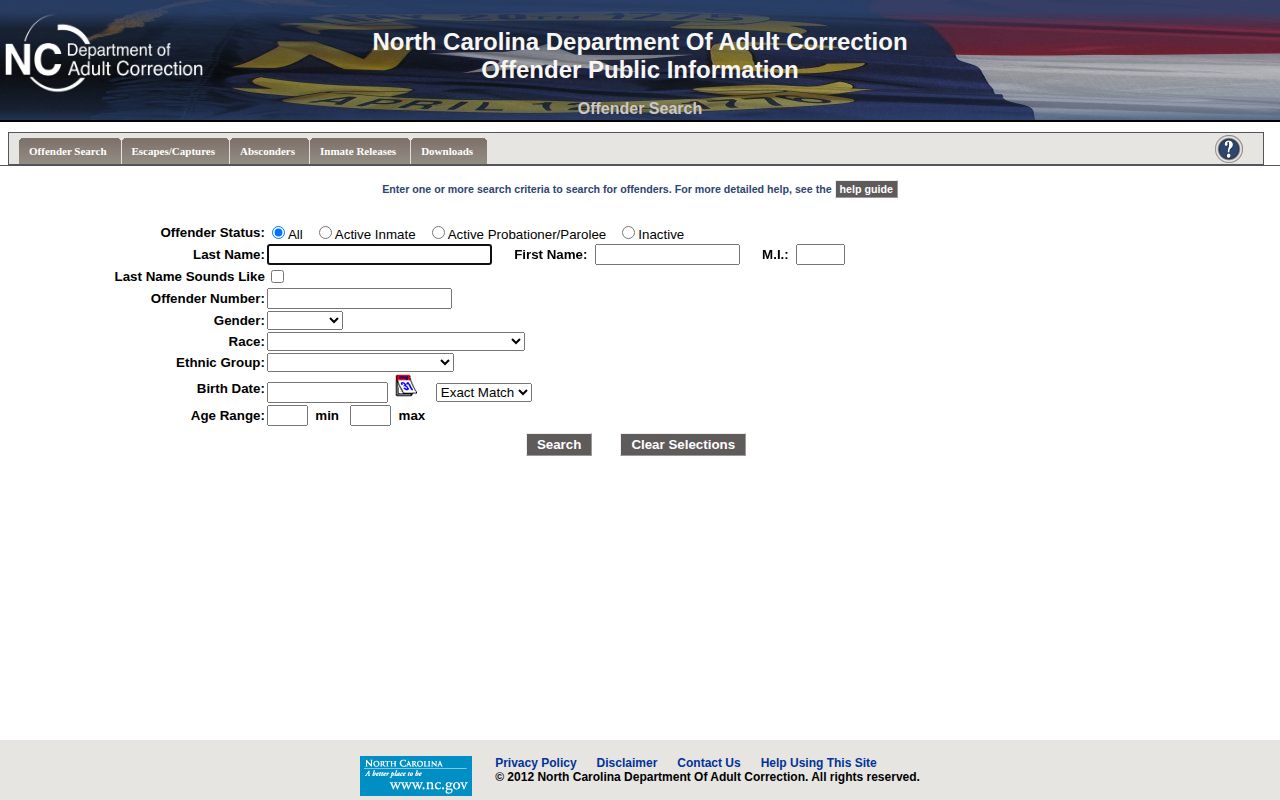
The individual result, not the search form or a name-only summary, supplies the sentence and release fields that need interpretation.
For a county case, the Halifax County Clerk can provide the judgment or order. The Clerk does not compute the jail's operational release time. The Detention Center at 252-583-3081 is the right local source for the jail calculation and physical-release status.
Note: A projected date never proves that the person has already left the named jail or prison.
Halifax County Felony Release Calculations
North Carolina structured sentencing uses minimum and maximum felony terms. Under G.S. 15A-1340.13(d), a state prisoner must serve the minimum term imposed. Earned time awarded under lawful NCDAC rules may reduce the maximum term, but it cannot reduce the term below the minimum. This is the central rule for a modern state felony projection.
The maximum term also accounts for the post-release supervision framework in Article 84A when it applies. Release from prison may therefore start a new community-supervision status rather than end every correctional obligation. Read both “Inmate Status” and “Probation/Parole/Post Release Status” on the individual record. An actual prison exit plus active post-release supervision is different from final discharge.
Court-ordered confinement credit also matters. G.S. 15A-1355 addresses the start of terms and relevant credit calculations, while related jail-credit law may affect how time already served is applied. The court's judgment and NCDAC's live calculation are the authorities for one person. A docket summary cannot safely be turned into an independent release calendar.
One offender record may contain several convictions and admissions. Concurrent terms run together as ordered, while consecutive terms follow one another. An additional judgment can alter the controlling term. That is why the sentence history, service status, sentence status, minimum, maximum, actual release date, and any parole fields must be reviewed together.
Halifax County Has No 85% Rule
North Carolina has no blanket state rule that every prisoner serves about 85 percent of a sentence. That figure is often borrowed from simplified discussions of federal good-conduct time. It should not be applied to NCDAC or Halifax County jail records.
For a structured-sentencing felony, the more accurate shorthand is service of 100 percent of the imposed minimum, with lawful credit for qualifying pretrial confinement. Earned time operates on the maximum and may bring it down only to the minimum. The calculation can also reflect the applicable post-release supervision portion. These pieces cannot be replaced with one percentage.
Parole does not supply a broad modern percentage either. NCDAC explains that parole mainly concerns offenses committed before October 1, 1994, when structured sentencing took effect. Those legacy cases depend on the offense date, the law governing the old sentence, and Commission action. Modern post-release supervision is not parole and should not be used as an interchangeable label.
Halifax County Misdemeanor Release Credits
A local Halifax County misdemeanant follows a different statutory framework from an NCDAC felony prisoner. G.S. 15A-1340.20 provides that each imposed day is served except for authorized credits and caps combined earned credit at four days per month. This is a ceiling, not a promise that every person receives the full amount.
G.S. 162-60 permits a county custodian to award qualifying reductions for work, education, training, treatment, and other programs under the law's terms. No published Halifax County policy establishing an automatic local award formula was found. The Halifax jail record and custodian's calculation must establish what credit was actually awarded in one case.
The distinction matters. Applying the felony minimum and maximum rule to a local misdemeanor would be wrong. So would applying the misdemeanor four-days-per-month ceiling to a state felony record. The judgment identifies the sentence, the court supplies authorized jail credit, and the correct custodian applies the governing calculation.
| Custody and sentence | Controlling approach | Authority to confirm |
|---|---|---|
| County pretrial detention | No fixed projected date; bond, court action, holds, and disposition control. | Halifax court order plus Detention Center status. |
| County misdemeanor term | Authorized jail credit and local earned credit, capped as state law provides. | Judgment and Halifax custodian's calculation. |
| State structured felony | Minimum and maximum terms; earned time cannot reduce below the minimum. | NCDAC individual record and sentence calculation. |
| Legacy parole case | Offense-date law and Commission review apply. | NCDAC status and Commission record. |
Note: A credit statute sets legal bounds, while the person's official sentence record shows the result actually applied.
What Changes Halifax County Release Dates
A projected release date is a snapshot of the current calculation. Some changes move the estimate because the legal sentence changes. Others affect whether a person can leave the current facility even when the sentence date remains the same. The record should identify which kind of event occurred.
| Factor | Possible effect | Best verification |
|---|---|---|
| Earned-time award or loss | May reduce or restore the maximum within legal limits, or move the displayed estimate after discipline. | NCDAC or county custodian's current calculation. |
| Jail credit | Qualifying pretrial confinement may count toward the term as ordered. | Judgment, credit order, and sentence record. |
| Additional judgment | A new sentence or corrected judgment may change the controlling term. | Court order and updated sentence history. |
| Concurrent or consecutive terms | Sentence structure changes which term controls the end date. | Full judgment set and NCDAC calculation. |
| Detainer or other hold | The person may leave one custody but transfer to another agency instead of entering the community. | Releasing and receiving-agency records. |
| Commission or court action | A lawful decision can change release or supervision timing. | Commission decision, court order, and later movement entry. |
Disciplinary credit loss or restoration should not be guessed from a changed date. Request an authoritative recalculation with the NCDAC offender number. For Halifax County jail cases, request the entry and release summary, release order, and any maintained calculation rather than assuming why a date moved.
A detainer creates a common false conclusion. Departure from Halifax County custody may be a transfer to NCDAC, another jail, federal custody, or immigration custody. The Halifax release event proves only that one custody ended. The receiving agency must confirm what followed.
Confirm Halifax County Actual Release
After the projected day passes, reopen the NCDAC individual record. In sentence history, look for service status, sentence status, actual release date, release-type movement, and any new supervision entry. An actual release date paired with no active incarceration is stronger evidence of a prison exit than a projected field or a row in the cohort search.
The dedicated NCDAC Inmate Releases search can help find state-system releases by release county, year, month, or last name. “Release County = Halifax” means NCDAC associates that state release with Halifax. It does not mean the Halifax County Detention Center released the person. Open the individual record before interpreting the result.
For local custody, call the Detention Center and request documentary proof when needed. The Sheriff's short-window inmate search is not a sentence calculator, and a name disappearing from the live roster does not prove community release. The Halifax County release record process explains how the jail entry and release summary, court order, and receiving-agency record fit together.
NC SAVAN provides another event channel. Register through the VINELink Inmate Search before the expected change and select the correct booking or offender record. A transfer alert requires follow-up and re-registration for the receiving custody. Notifications support timely checks, but the jail or NCDAC record remains the source for the final date.