
Halifax County Supervision Types
North Carolina uses three distinct community statuses. The North Carolina Department of Adult Correction, or NCDAC, supervises people in the field through its Division of Community Supervision. The North Carolina Post-Release Supervision and Parole Commission makes parole and post-release decisions within its legal authority. Those roles are related, but they are not the same.
Probation is a court sentence that can begin without a state-prison stay. Parole is a conditional release route that NCDAC says mainly applies to offenses committed before October 1, 1994. Structured sentencing ended parole for later offenses. A person leaving a modern felony prison term will often begin mandatory post-release supervision under Article 84A instead. Calling all three statuses “parole” hides the legal path and may create a false release history.
| Status | How it begins | What to verify |
|---|---|---|
| Probation | A court imposes community supervision, sometimes instead of prison. | Court judgment, active NCDAC supervision status, dates, and unit. |
| Parole | The Commission conditionally releases a person sentenced under older law. | Legacy offense date, parole status, Commission action, and prison movement. |
| Post-release supervision | Supervision follows a structured-sentence prison term under Article 84A. | Actual prison release, post-release status, start and end dates, and unit. |
A community status does not mean current jail custody. Likewise, a probation record does not prove the person was released from a North Carolina prison. The Halifax County released-inmate search and records paths separate a county booking, state prison episode, court order, and later supervision record.
- Discharge
- The formal end of a supervision term or correctional status.
- Absconder
- A person whom Community Supervision has classified as having lost contact or failed supervision requirements.
- Detainer
- A request or legal process through which another agency may seek continued custody.
Verify Halifax County Supervision
The official starting point is the NCDAC Criminal Offender Searches gateway. Its Offender Public Information system covers state prisoners, probationers, and parolees, with historical data reaching back to 1972. It does not contain Halifax County jail records. Use the exact source that matches the custody or supervision question.
One person may have more than one sentence or supervision episode. An NCDAC offender number is the best way to keep the records straight. A name-only result should be matched with supported details such as age, offense, county, and status. Open the individual record because a summary result cannot show the full incarceration and supervision history.
- Enter the person's NCDAC offender number when known. Otherwise, search the legal name and carefully match identifying details.
- Read both “Inmate Status” and “Probation/Parole/Post Release Status.” Do not infer one from the other.
- Identify whether the record reflects probation only, legacy parole, or post-release supervision after prison.
- Record the active status, supervision type, start and end dates, and office or unit label actually displayed.
- Use the Community Supervision office directory to identify the current office. Call with the offender number if the unit label is unclear.
- For a release question, confirm the actual prison movement or release entry separately. Supervision data alone does not establish the time of physical release.
NC SAVAN adds a separate notification channel. The state service links North Carolina jails with Adult Correction prison, probation, and parole data. A person can be searched through North Carolina VINELink, and future event alerts may be registered against the correct booking or offender number. A county booking ID and NCDAC number are different, so a transfer may require a new search and registration.
Note: A missing web result means only that the person was not found in that source at that time.
Halifax County District 6 Office
Halifax County is part of Community Supervision Judicial District 6 with Bertie, Hertford, and Northampton counties. The office directory dated July 15, 2024 listed the district office in the Hertford County Courthouse. An individual record may use a more detailed label such as “DISTRICT 06 UNIT A.” Match that current record label before calling because offices, units, and contact assignments can change.
NCDAC Community Supervision District 6
Hertford County Courthouse
119 Justice Drive, First Floor
Winton, NC 27986
Phone: 252-649-2007
Fax: 252-358-0127
Directory information dated July 15, 2024. Check the current official directory before relying on it.
The field office can help identify the responsible reporting location and explain what public verification is available. It should not be asked for a person's private reporting schedule or safety-sensitive details. When the question concerns a Halifax court judgment rather than field supervision, use the Halifax County court contact directory and request the order from the Clerk.
The official NCDAC office directory shows how supervision offices are organized across the state.
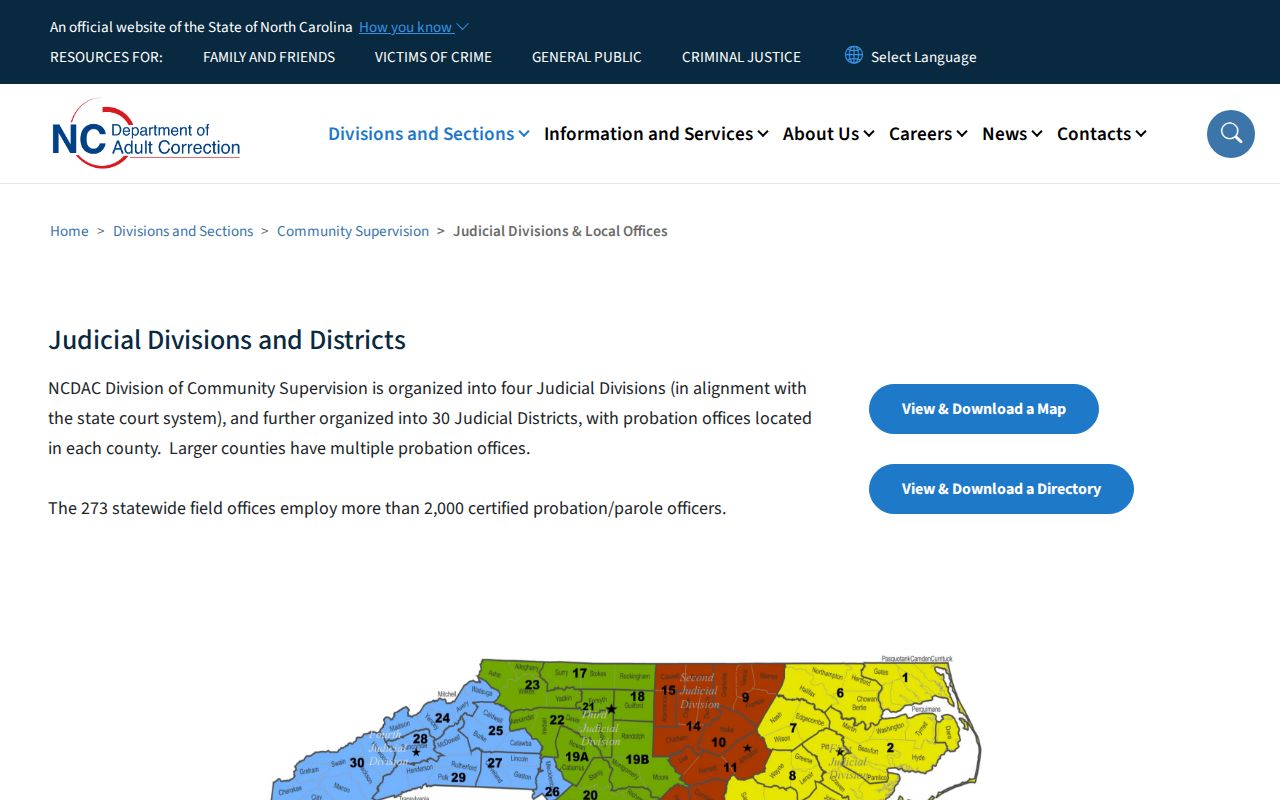
The live directory, not an old staff name, is the right source when a Halifax supervision unit changes.
Halifax County Absconder Records
NCDAC provides a dedicated Offender Absconders search. An entry means Community Supervision classified the person as having lost contact or failed supervision requirements. It does not state that a new offense resulted in conviction. It also is not automatic proof of a live arrest warrant or current Halifax County jail custody.
Use the displayed status as a lead. Then review the person's NCDAC record, identify the listed supervision unit, and check the responsible court or agency for any warrant that may be publicly confirmed. If the person appears in the Halifax Sheriff's inmate search, that result supports present county custody, not the reason for the absconder label. If no jail entry appears, do not call the person released or still at large based on absence alone.
Conditions and violations are case-specific. Community supervision can include requirements set by law, the court, or the Commission. Article 84A governs modern post-release supervision, including conditions, violations, and termination. The public record should be reported by its actual label rather than expanded into a claim the source does not make.
Note: Confirm a warrant with the issuing court or agency instead of treating an absconder result as a warrant record.
Halifax County Parole File Reviews
North Carolina does not publish a future, name-by-name parole hearing calendar because the Commission says it does not hold formal hearings. Commissioners review files individually, and a majority of the four commissioners is required for a decision. They do not meet personally with the person under review. A meeting notice or agency agenda should never be presented as proof that a named Halifax County person received a hearing.
The nearest public results source is the Commission's Discretionary Parole Reviews page. Its monthly reports are retrospective and begin in September 2024. They may use exact categories such as “Incomplete Decision,” “Suspend Decision,” and “Regular Parole.” Those terms have defined meanings. A regular-parole decision is conditional supervised release before sentence expiration, while an incomplete decision may mean more information is needed.
The Commission's official process page states that cases use file review rather than a formal calendar.
For one person, combine the NCDAC offender number, offense date, live status, relevant monthly report, and a direct Commission inquiry. A decision still is not physical-release proof until NCDAC records the prison movement or release.
Correct Halifax County Supervision Records
An error should go to the custodian that created the disputed record. The Sheriff's Office, led by Sheriff Tyree Davis, maintains the county booking and release summary. The official HCSO FAQ routes jail, Magistrate, and court questions by topic. The Halifax Clerk maintains court orders and docket entries. NCDAC maintains offender movement, incarceration, and supervision status. Sending a broad request to the wrong office can delay review and blur which record is alleged to be wrong.
A focused written correction request should identify the booking number, NCDAC offender number, or court file number and the exact field at issue. Attach the official order or record that contradicts it. Do not post dates of birth, confidential identifiers, or supervision details in a public forum. NCDAC questions can be routed through Constituent Services; Halifax court matters belong with the Clerk; and county release-summary issues belong with the Sheriff's records custodian.
Correction and expunction are different. A correction addresses inaccurate data. An expunction is a court process that may remove, seal, or destroy eligible arrest, charge, or conviction records. Some routes require the whole sentence, including supervision, to end before a statute-specific waiting period starts.
Halifax County Supervision Discharge
Supervision ends through the legal process that governs the specific status. A probation term follows the judgment and later court or agency action. Post-release supervision is controlled by Article 84A and Commission authority. Legacy parole follows the law tied to the offense date. There is no safe universal end-date formula for all Halifax County records.
Read the NCDAC record for an end date and a final status such as discharged or inactive, then check the court or Commission record if the transition needs formal proof. A projected end date is not the same as an actual discharge. The record may also contain more than one active or closed sentence, so verify each episode rather than relying on the first date displayed.
NC SAVAN can send supervision-related events, but notifications supplement direct checks. For a durable record, request the relevant NCDAC status or movement material and keep the offender number with the response. If an expunction later makes a qualifying record unavailable, respect that lawful result rather than treating the missing item as a system failure.