
Halifax County Release Meaning
A release means a person departed from a named custody. It does not always mean the person went home. Someone may leave the Halifax County Detention Center after bond, dismissal, time served, or completion of a local sentence. The same jail exit can also be a transfer to the North Carolina Department of Adult Correction, another jail, federal custody, or immigration custody. The release record should name the event and, when maintained, the destination or receiving agency.
The county jail and Roanoke River Correctional Institution are separate systems. The Sheriff keeps the local booking and release record. NCDAC maintains state prison movements, actual release dates, and supervision status. The Halifax Magistrate or a judge may authorize an exit, while jail staff document physical release. A court order explains legal authority, but it may not show the exact minute every hold cleared.
Halifax County Release Types
The event label controls how a Halifax County release should be read. “Released” is a broad custody term. The supporting court, jail, state, or federal record gives it a more exact meaning.
| Release type | What it means and where to verify |
|---|---|
| Bond or pretrial release | The person left the jail while the case stayed open. Confirm the jail exit and court bond conditions. |
| Dismissed or not guilty | A charge ended, but another case or hold may delay release. Check all listed process. |
| Time served or sentence complete | The judgment and jail credit explain the term. The entry and release summary proves departure. |
| Transfer | Halifax custody ended, but another jail, NCDAC, BOP, or ICE may still hold the person. |
| Post-release supervision or parole | The person is outside prison but remains under state supervision. |
| Probation | This can follow jail or begin without prison. An NCDAC listing alone does not prove a state-prison release. |
| Escape or death | Custody ended or physical presence changed, but neither event should be described as a normal release. |
These distinctions guard against a common error. A transfer from the Halifax County Detention Center to Roanoke River or another state institution is not freedom from custody. Likewise, post-release supervision is a release from prison with legal conditions still in force.
Note: Match the source's exact event label before describing what happened after a Halifax County release.
Halifax County Release Record Fields
No single form contains every fact. A focused request may seek a booking or arrest sheet, entry and release summary, commitment or release order, pretrial-release agreement, and charge or bond history. Those are distinct records that can be tied together by a booking number, case number, and dates.
| Field | What it shows |
|---|---|
| Full name and aliases | Identity as recorded for the booking or offender episode. |
| Date of birth or age | A way to separate people with similar names. |
| Booking, inmate, or offender number | The durable key for the county, state, or federal record. |
| Admit date and time | When the specific custody episode began. |
| Release date and time | When the person left that custodian, if maintained in the record. |
| Release category or authority | Bond, order, sentence completion, transfer, or another coded event. |
| Charge, bond, and case number | The court matter linked to the booking and release decision. |
| Releasing or receiving agency | Whether the person entered the community or another custody. |
| Supervision status | Whether probation, parole, or post-release supervision followed. |
A photograph may help distinguish namesakes, but it records the booking event. It does not prove guilt, release, or current status. The Halifax jail's public list observed during research showed name, age, race, sex, admit date, and a detail link. A release reason, timestamp, bond amount, or photo should not be assumed unless the released detail or retained record actually shows it.
Request Halifax County Release Records
For a county booking, direct a narrow request to the Halifax County Sheriff's Office records custodian at 355 Ferrell Lane, P.O. Box 36, Halifax, NC 27839. The main number is 252-583-8201, and the fax is 252-583-2698. For a current operational check, Detention can be reached at 252-583-3081. Ask for the preferred submission channel before sending private identifiers by ordinary email.
- Give the full name, date of birth or booking number, and a narrow admission date range.
- Ask for existing non-medical records, such as the booking sheet, entry and release summary, release order, coded reason, and receiving agency.
- Request electronic copies if the office can provide them. Ask that exempt parts be redacted instead of withholding the public remainder.
- Ask for the legal basis in writing if an item is denied. Do not require the office to create a new report or narrative.
- If the Sheriff no longer has the record, check the Halifax Clerk, NCDAC, or the documented receiving agency.
G.S. 132-6 requires access at reasonable times and copies as promptly as possible, but it sets no fixed number of days. G.S. 132-6.2 permits a medium the agency can provide and limits ordinary uncertified-copy charges to actual reproduction cost. A special service charge may apply when a request needs extensive technology or staff time. Halifax publishes no special release-record fee schedule, so ask for an estimate.
The county sheriff retention schedule authorizes destruction of inmate incarceration records three years after release or transfer. That period is not an online display promise. The public released search has a much shorter window. Older court and NCDAC histories follow other rules and may remain available after a county record reaches its authorized disposition point.
Correct Halifax County Release Records
An error should go to the custodian that created the disputed field. Send a Halifax booking or release-summary issue to HCSO. Send a judgment or docket error to the Halifax Clerk of Superior Court. Direct an offender movement, prison-release, or supervision issue to NCDAC Constituent Services.
A focused correction request should state the booking, offender, or file number, identify the exact field, and attach a conflicting official order when one exists. Avoid posting birth dates, identification numbers, or private contact details in a public channel. A missing web result is not enough to prove an error because short display windows, lawful sealing, aliases, and transfers can all change what appears.
Note: Ask each Halifax custodian to correct only the record it owns and to preserve lawful redactions.
Halifax Bond Authorization and Release
The Sheriff's local FAQ separates release authorization from physical release. Questions about what is required to obtain release go to the Halifax Magistrate at 252-593-3019. The Judicial Branch also provides an official licensed bail-bondsman finder. Payment or authorization begins the process, but it does not prove that every hold has cleared.
Use the jail's entry and release event to confirm that the person actually left. Then review the court case for bond terms and the next case event. A second charge, detainer, or receiving agency can keep the person in custody after one bond is addressed. This is why a receipt, order, or roster disappearance must be paired with the custody record.
Halifax Release Records and Expunction
North Carolina Chapter 132 broadly defines public records, while other laws protect sealed, expunged, juvenile, medical, victim, and some investigative material. G.S. 162-57 requires the jailer to keep identifying information and commitment or release authority. Access does not mean every document is unrestricted, online, or kept forever.
An expunction can remove and seal or destroy eligible state arrest, charge, or conviction records. The route depends on the outcome and statute. Some dismissed or not-guilty matters may qualify sooner, while other paths require the full sentence, including supervision, to end before a waiting period begins. There is no one Halifax wait time that fits every case.
When a record is lawfully sealed or expunged, its absence should be respected. Do not reconstruct it from old copies. A negative search can also mean a misspelling, data delay, an expired county window, the wrong custody source, or an older record. The accurate statement is that the person was not found in that source at that time.
Find Halifax County Released Inmates
Start with the likely custodian and date. Recent local bookings belong with the Sheriff. State prison terms and state supervision belong with NCDAC. Halifax court records explain disposition, bond, judgment, jail credit, and release orders. BOP covers federal sentences, while ICE ODLS addresses current immigration detention. Each system answers a different question.
- For a local booking within the prior day, open the Sheriff's inmate-search wrapper and look for its Released Inmates mode.
- Match more than the name. Use age, booking number, case number, dates, and agency when available.
- If the county mode is missing or the event is older, call Detention and request the entry and release summary.
- Check Halifax eCourts for the order or disposition that explains the local case.
- Search NCDAC when state prison, probation, parole, post-release supervision, or a transfer may apply.
- Use VINELink or NC SAVAN for custody events, then confirm transfers with the receiving agency.
- Use BOP or ICE only when federal or immigration custody is supported by the facts.
Do not turn a blank result into a conclusion. Names change, aliases differ, selected records may be excluded, and a county record can age out of the public window. A person may also have moved to a system that uses a different ID.
Halifax County 24-Hour Release Search
The official HCSO inmate-search page says Released Inmates searches are limited to the previous 24-hour period. It does not define an exact refresh time or promise a midnight-to-midnight report. The live application also warns that information can change fast and selected people may be excluded.
The Sheriff's source page shown below documents the narrow county window.
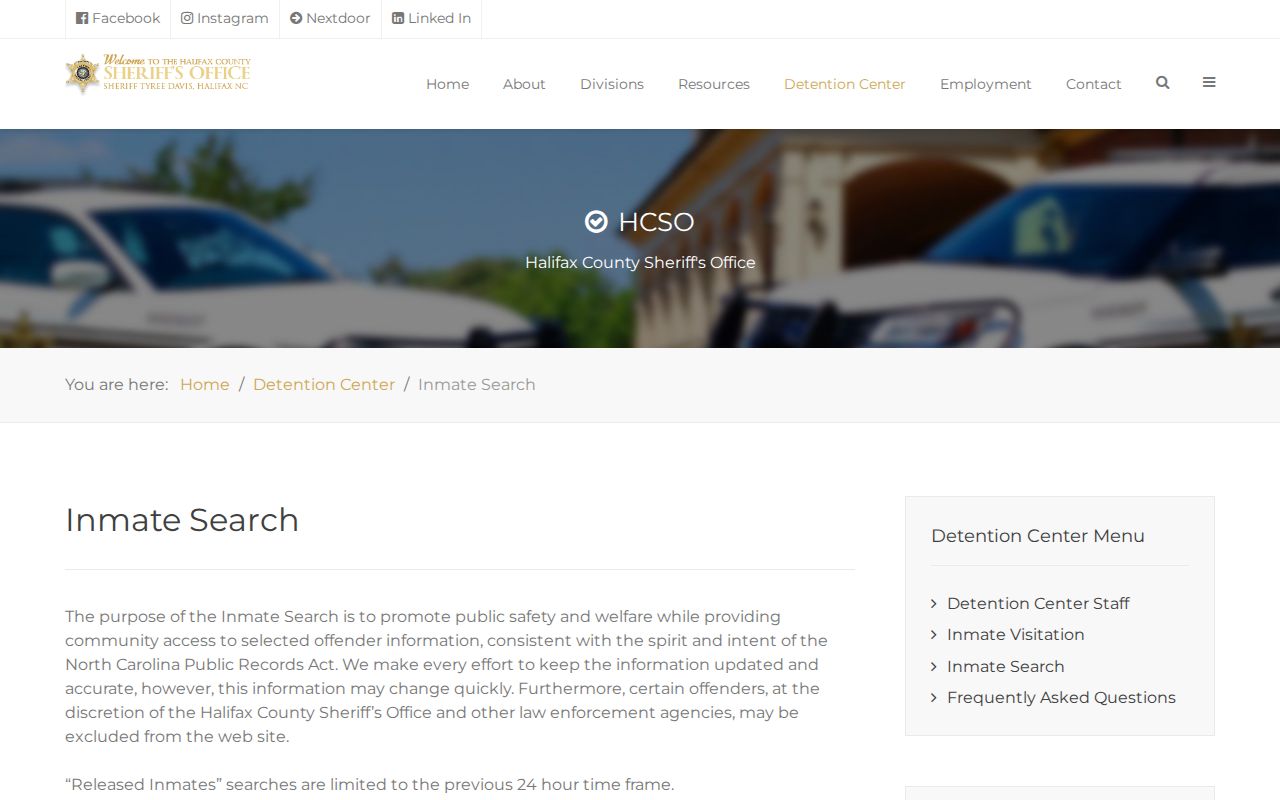
This county view is a short discovery tool, not a long-term release archive.
On July 30, 2026, released-route names in the application redirected into current-inmate pages. That dated observation may reflect a temporary or software issue. If Released mode does not appear, call Detention, use NC SAVAN, or request the record. No separate official Halifax 72-hour released list was found, and the current-inmate “last number of days” control must not be treated as one.
Note: The one-day web window and the three-year county retention authority describe two different forms of access.
NCDAC Search for Halifax Releases
The NCDAC Criminal Offender Searches gateway covers state prisoners, probationers, and parolees, with history back to 1972. It excludes county-jail information. Search by offender number when possible, then open the individual record and compare identity, incarceration status, movement, actual release date, sentence history, and supervision status.
The NCDAC gateway pictured below makes the state and county boundary clear.

A Halifax County jail booking will not appear there unless the person also has a state corrections or supervision record.
The dedicated NCDAC Inmate Releases tool can filter by release county, year, month, or name. Its rows can show offender number, name, release date, primary offense, and type of release. “Release County = Halifax” means NCDAC associates the state release with Halifax. It does not mean the Halifax County Detention Center made the release. Confirm the individual page before interpreting a cohort row.
- Projected release date
- A forward estimate for an active state term. It is not proof of release.
- Actual release date
- A historical date tied to the completed prison episode.
- Post-release supervision
- Community supervision after prison under modern structured sentencing.
- Parole
- A conditional release path that mainly applies to older-law cases.
- Probation
- A community sentence that may begin without a prison term.
Halifax Release Notifications and Supervision
North Carolina calls its statewide service NC SAVAN, delivered through VINELink and by phone at 1-877-627-2826. It links all North Carolina jails with Adult Correction prison, probation, and parole. Search the exact person, match the agency and booking or offender ID, and read the event label. Alerts can report release, transfer, escape, or capture.
A county booking ID and an NCDAC offender number are different. After a transfer, the state directs users to register again for the receiving custody. A transfer alert therefore should not be read as community release. NCDAC's individual record can also show active probation, parole, or post-release status. Field supervision is handled by the Division of Community Supervision, while the Post-Release Supervision and Parole Commission makes decisions within its jurisdiction.
The NC Sex Offender Registry is not a general release list. It covers only people with a current duty to register. Use it only for its stated public-safety record and comply with its restrictions against threats, intimidation, stalking, or harassment.
Halifax Court Orders and Release
Halifax release authority is split among the jail, Magistrate, and Clerk. The Sheriff's FAQ sends release-requirement questions to the Halifax Magistrate, but it directs court and attorney questions to Judicial Branch channels. The jail documents departure. The case file explains the legal event that allowed or required it.
eCourts covers Halifax following statewide completion in 2025. Search Portal by party or record number, filter to Halifax, and match the file number. Check bond events, disposition, judgment, sentence, jail credit, probation, and release orders. When an online label is unclear, call the Clerk at 252-593-3000 and request the order or paper file. A public terminal remains a durable fallback.
Court disposition and physical release answer different questions. A dismissal can coexist with another hold, while a time-served judgment still must pass through jail processing. Pair the order with a jail release entry or custody event.
Halifax ICE Detainers After Release
North Carolina G.S. 162-62 sets a defined process for qualifying immigration detainer custody. It requires release upon the earliest statutory condition, which can include ICE taking custody or a time limit. A person may therefore leave the Halifax jail roster while remaining in immigration custody.
Ask HCSO for the releasing or receiving agency entry. Then use ICE's Online Detainee Locator for current detention by A-number and country of birth or by biographical data. ODLS is not a historical discharge archive, and absence there is not proof of release. Halifax County has no verified dedicated ICE detention facility, so this is a conditional path, not a routine county release route.
Halifax County Release Facilities
Halifax has both a county jail and a state prison, and their release records do not merge. The current county jail facts remain controlling until Halifax County and the Sheriff announce that the new detention-center project is operational.
Halifax County Detention Center holds local pretrial and short-term sentenced detainees. Its exit can lead to the community or another custodian. Roanoke River Correctional Institution is an NCDAC medium and minimum custody prison and reentry facility. Formerly named Caledonia Correctional Institution, it was renamed in 2021. Its releases and transfers are verified in NCDAC, not in the county jail list.
A move between state prisons is a transfer. An actual state exit should have a release or movement entry, followed when applicable by a supervision status. The older Caledonia name remains useful when reviewing historical records.
Note: Confirm the active Halifax release address and procedure before arranging pickup or requesting a facility-specific record.
Halifax Released or Still Held
Use the source that owns the custody event. A current-custody list cannot replace a release record, and a court case cannot replace the jail's physical exit time.
| Situation | Best source | What to confirm |
|---|---|---|
| Still in Halifax jail | HCSO live inmate search or Detention | Current booking, admit date, and active custody. |
| Recently left Halifax jail | Released mode, Detention, entry and release summary | Time, reason, and receiving agency. |
| State prison or state supervision | NCDAC individual record | Incarceration status, actual release, movement, and supervision. |
| Local legal outcome | eCourts and Halifax Clerk | Bond, order, disposition, judgment, and jail credit. |
| Federal sentence | BOP Inmate Locator | Federal status and release date where available. |
| Current immigration detention | ICE ODLS | Current location, followed by agency confirmation. |
When the systems disagree, use the booking, offender, or case number and call the agency that created the newest event. Record the exact label and date. Do not merge separate custody episodes into one claim.